ARTWORK ANALYSIS – Between Renaissance, Glass, and the Digital Revolution
Imagine a dialogue between the genius of Leonardo da Vinci, the tragedy of 9/11, the frenzy of social networks, and the thousand-year-old tradition of Murano glass.
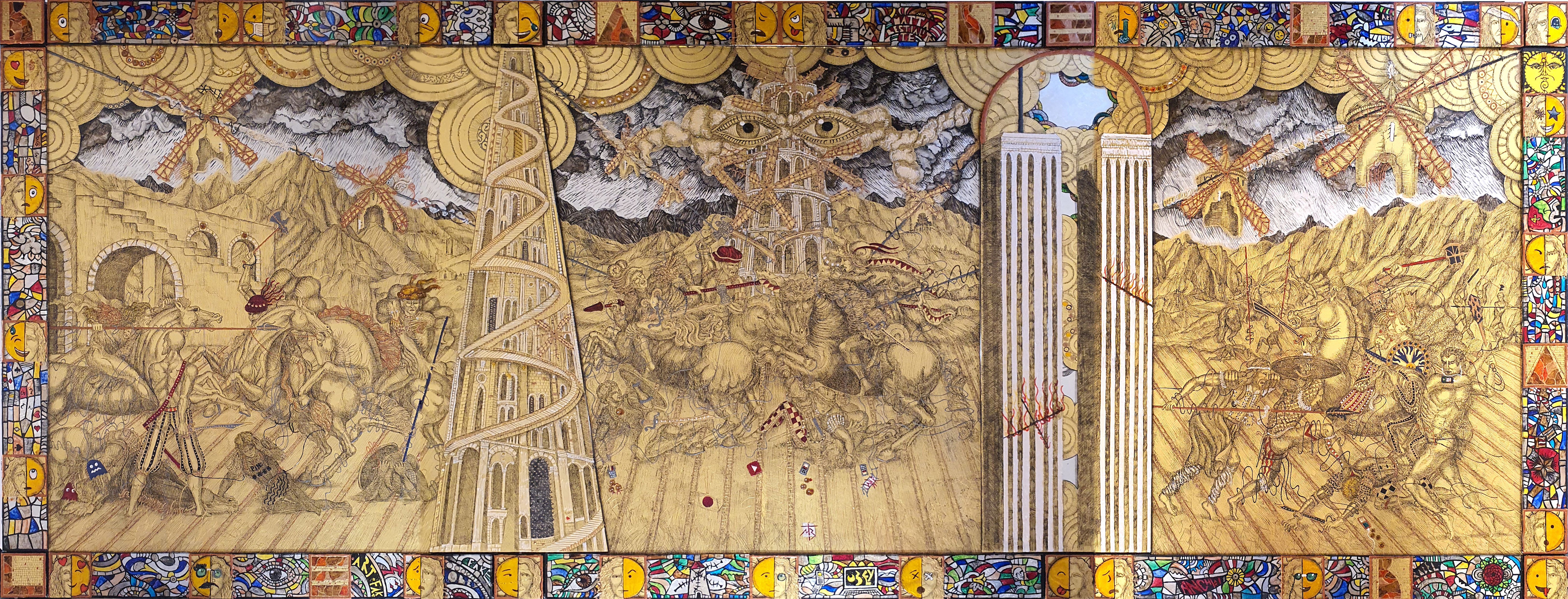
All of this comes to life in ‘ANGHIARI’, an extraordinary 170×70 cm glass masterpiece created by maestro Marco Toso Borella.
This work represents one of the absolute pinnacles of the BABEL collection, now on display in the cradle of world glassmaking: the Murano Glass Museum.
This artwork is not a sudden spark of inspiration, but the crowning achievement of a lifelong quest.
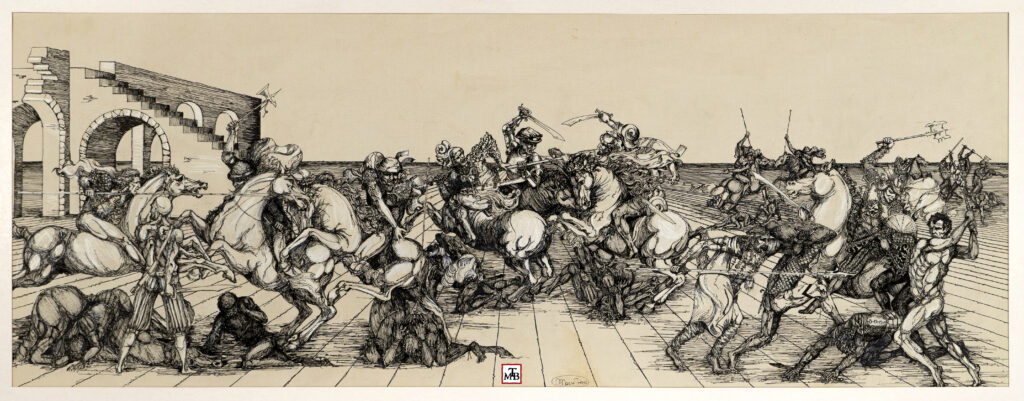
Since the age of seventeen, the artist has studied almost obsessively the few surviving sketches of the Battle of Anghiari, the legendary lost fresco by Leonardo da Vinci.
Toso Borella sought to reconstruct this masterpiece not to create a simple copy, but to lay bare its philosophical soul: what Leonardo and Dante defined as ‘matta bestialitade’—the mad bestiality and sheer madness of war that turns men into beasts and infects even animals.”
Past and present merge into a visual labyrinth
The artwork unfolds like a story read from left to right, set upon a floor with a vanishing perspective typical of the Renaissance.
On the left: The majestic Tower of Babel rises toward the sky among mountains and windmills that evoke both the dreamlike world of Don Quixote and the new frontier of warfare: drones. It stands as the symbol of human pride, primal animal instinct, hyper-technological evil, and the confusion of tongues
Yet, the space in which the actors of ‘ANGHIARI’ move is timeless, a metaphysical limbo where centuries collapse into one another:
On the left, the majestic Tower of Babel—the Ziggurat that rises toward the sky among mountains and windmills, evoking both the dreamlike world of Don Quixote and the new frontier of warfare: drones. It stands as a symbol of human pride, primal animal instinct, hyper-technological evil, and the confusion of tongues.
In the center, the pulsing heart of the Leonardesque battle explodes. Knights and steeds merge into a wild muscular tangle to seize a flag soaked in hatred. Watching over them are two large central eyes, the mirror of an ‘algorithmic technological God’ that sees, controls, and censures everything.
Yet, if we look closely at the warriors, the anachronism becomes ironic and provocative: emerging amidst lances and armor are smartphones, social network logos, earphones tucked in ears to isolate themselves from the world, and even the running armbands used by modern joggers.
Humanity fights and destroys itself, yet it remains distracted and hypnotized by its own screens
Amidst the chaos, even Pac-Man appears—the video game icon, used here as a metaphor for the greed of our society that devours everything.
On the right, the conflict lands in our recent history. The Leonardesque battle mirrors itself directly in the tragedy of the collapse of the Twin Towers, wounded by a pouring flow of dark smoke. Yet, right above the towers, a clear sky seems to open up—a rare glimmer of light evoking a possibility of hope or a silent, cosmic truce.
A frame that ‘speaks’ through emoticons
While the center of the artwork is dominated by the monochrome warmth of gold, the perimeter explodes into a marvelous cathedral stained-glass effect. This vibrant, colorful frame, rich in mosaic tiles and striking contrasts, encloses the scene like a biological clock of our civilization.
Moving within it are emoticons cut in half: digital smiley faces that reduce our deepest emotions—joy, pain, and anger, painted in their true reality upon the face of the Vitruvian Man—to mere halved pixels, mirroring a contemporary communication that has become deeply fragmented and superficial.
The Value for the World of Murano Glass
The value of this artwork reaches its peak in the gold-leaf graffito technique, which has belonged to the ancestors of the Toso Borella family for centuries and was historically used to decorate small objects and precious vases. The great historical and artistic merit of Marco Toso Borella lies in having revolutionized this tradition, transforming it from pure decorative craftsmanship into a monumental and conceptual pictorial language
Through the Murano Glass Gold Graffito 3D technique, the artist applies a highly precious 24-karat gold leaf and enamels onto the glass, and then, using ultra-fine steel points, scratches the surface by subtraction. It is a powerful and poetic gesture that evokes the famous ‘Cerca trova’ (Seek and ye shall find) enigma left by Vasari in Palazzo Vecchio in Florence—beneath whose fresco, according to the artist, Leonardo’s original painting remains hidden to this day
The Deep Meaning Within ‘BABEL Within the BABEL exhibition, this artwork represents the political and philosophical heart of the entire exhibition path. The collection reflects upon the deep conflict between the real and digital worlds, between biological humanity and technological alienation.
By combining the eternal splendor of gold with the ancient fragility of Murano glass, ‘ANGHIARI’ delivers an urgent warning: in an era where we are all hyper-connected, we risk remaining dramatically alone, deaf to the cry for help of our neighbor, and prisoners of a new, chaotic technological Babel.